

The Question Nobody Budgets For Until It’s Too Late
A project ramps up. The workload justifies a new hire. Six months later the project wraps. The pipeline goes quiet, and that same hire is now a fixed cost with nothing to work on. Then a new project lands, and the hiring process starts all over again.
This cycle is common in construction, and it’s rarely accounted for when the first hiring decision gets made. Most firms budget for a salary. Almost none budget for the full cost of an in-house BIM staff hire. Even fewer budget for what it costs to let that person go six months later.
What In-House BIM Staff Actually Cost Beyond Salary
Salary is only one part of an employee’s cost. Payroll contributions, benefits, recruiting, software and equipment all affect the comparison. The examples below are illustrative Canadian planning scenarios prepared in October 2026, with all amounts in CAD. They use assumed salaries and overhead allowances, rather than a survey of BIM salaries or a quote for outsourced services.
The Statutory and Payroll Costs
In B.C., employer CPP and EI contributions have income bands and annual limits. The CRA’s 2026 payroll tables set the main employer CPP rate at 5.95%, CPP2 at 4% on the additional earnings band, and employer EI at 2.282%, subject to the applicable limits. CPP and EI alone should not be treated as a flat 10-15% of salary. Workers’ compensation, provincial levies and other costs must be budgeted separately where applicable.
Benefits and Insurance
Extended health, dental and disability coverage vary by plan and employer. Use actual benefit quotes and allow for paid non-productive time and overhead separately. In the examples below, the combined six-month allowance for payroll contributions, benefits and other overhead is assumed to be $17,400 for the $82,000 salary and $23,400 for the $110,000 salary. These allowances are scenario inputs, not statutory contribution rates or typical benefit premiums.
None of this shows up on the org chart. It shows up in the budget every month, whether the person has billable work that week or not.
What This Actually Looks Like on a Six-Month Project
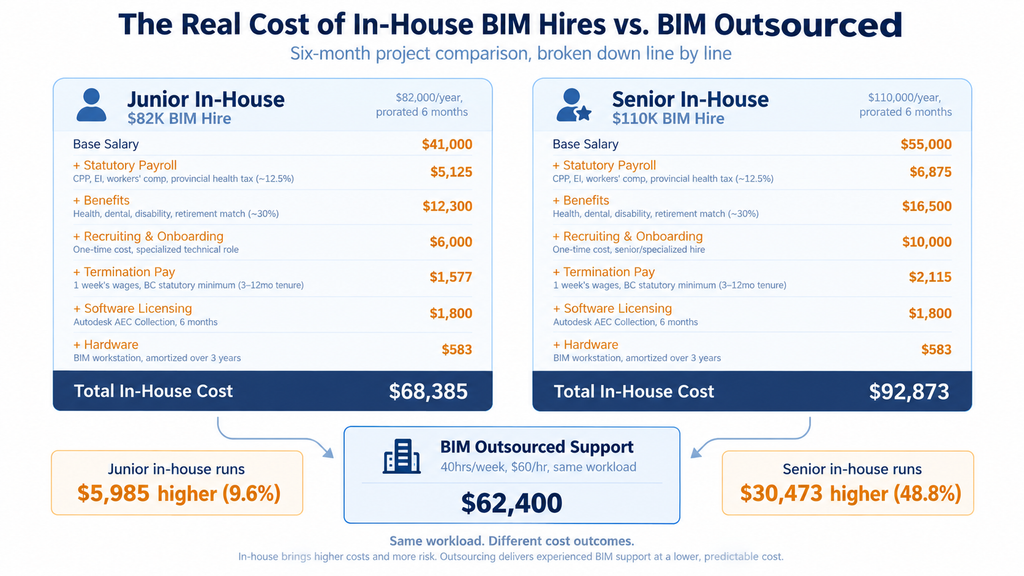
For the first scenario, assume an annual salary of $82,000. Six months of base salary is $41,000. Adding the assumed $17,400 combined payroll, benefits and overhead allowance gives $58,400. Add an assumed $6,000 for recruiting and onboarding, and the subtotal reaches $64,400.
This scenario also allows for termination pay and software. For covered B.C. employment lasting more than three months but less than a year, the general minimum is one week of notice and/or pay, subject to exceptions. The example assumes eligibility and pay in lieu of notice, about $1,577 at this salary. Contractual or common-law obligations can differ; see B.C.’s employment standards guidance. Software is a separate assumed budget of $1,800 for six months; confirm current products, currency and licence terms for the actual project.
For equipment, assume a $3,500 workstation allocated over a three-year useful life. That adds approximately $583 to this six-month scenario. An existing workstation, a different specification or another allocation method will change the result.
With those assumptions, the six-month in-house total is approximately $68,400. It is a scenario estimate, not a universal cost for hiring a BIM technician.
For comparison, an assumed outsourced rate of $60 per hour, for 40 hours per week over 26 weeks, totals $62,400 before applicable taxes. This assumes comparable scope and output. In this scenario, the in-house estimate is about $6,000 higher, or roughly 10%. Different utilisation, rates, overheads or deliverables can reverse the comparison.
Why the Salary Isn’t Always $82K
That example assumes a firm already has BIM standards, workflows, and someone in-house who can guide a newer technician. A lot of smaller firms, or firms just starting to bring BIM in-house, don’t have that yet. Without anyone senior enough to set direction and catch mistakes, a junior hire needs a level of hand-holding the firm often isn’t equipped to give.
A firm without internal BIM leadership may instead consider a more experienced hire. For the second scenario, assume a $110,000 annual salary and $10,000 in recruiting and onboarding. These are planning inputs for comparison, not claims about a typical starting salary or recruitment fee.
The senior scenario combines $55,000 in six-month base salary, the assumed $23,400 payroll/benefits/overhead allowance, $10,000 recruiting/onboarding, approximately $2,115 in assumed termination pay, $1,800 software and $583 equipment allocation. Rounded, that is $92,900. Against the assumed $62,400 outsourced total, the difference is about 49%. This result depends on those inputs and should be recalculated for the actual project.
That gap is the real argument for a firm new to BIM. Outsourcing doesn’t just avoid the cost of a senior in-house hire. It removes the reason that hire felt necessary in the first place. An outsourced BIM team brings its own experience. It works directly with whoever the firm already has, a site superintendent, a senior architect or engineer, a project manager. None of that requires the firm to already have BIM seniority on staff. The mentorship problem a junior in-house hire creates simply doesn’t come up.
The Hidden Cost of the Hire-Then-Layoff Cycle
Recruiting and Onboarding, Twice
Hiring costs money before the person even starts. Job postings, interview time, and a ramp-up period where a new hire is paid but isn’t yet fully productive all add up. Do that once and it’s a normal cost of doing business. Do it every time the pipeline swings from busy to quiet and back, and it turns into a recurring tax on the business instead.
What Happens When the Work Dries Up
Letting someone go isn’t free either, and it isn’t just a matter of goodwill. As the numbers above show, even a short-tenure termination carries a real statutory cost. There’s also a real cost in team morale and reputation, one that never shows up on a spreadsheet. A firm that hires aggressively during a busy stretch, then lays off during the next quiet one, pays for that volatility twice. It pays coming and going.
What Outsourcing Changes About the Math for In-House BIM Staff
Outsourced BIM support doesn’t remove cost, but it does two things at once. At a realistic salary, it’s often the cheaper option once you count every add-on cost, not just the hourly rate. And there’s a separate benefit too. No benefits load, no statutory contribution, no termination obligation once the workload drops. The relationship scales with the work itself, rather than running as a fixed cost regardless of pipeline.
That’s the fuller argument for outsourcing peak-period BIM work. It isn’t only that it removes fixed cost from the books during the slow months, though it does that too. At the salary a real BIM technician actually earns, the fully loaded comparison often favors outsourcing on cost alone. We’ve written before about what that decision looks like at the individual role level. That piece covers hiring a BIM technician versus bringing in support for a specific project.
When In-House BIM Staff Still Make Sense
None of this means outsourcing is always the right call. A firm with a steady, predictable pipeline in one discipline gets real value from a dedicated in-house hire. That kind of institutional knowledge and continuity is hard for project-based support to fully replace. The math above matters most when the workload is genuinely uneven. It matters far less when a role is simply steady but modest, and the firm needs it year-round regardless.
The real question isn’t whether in-house staff cost more than outsourcing. That depends on the salary and the scope, as the numbers above show. The real question is whether the workload behind that role is steady enough to justify carrying its full loaded cost through the quiet months, not just the busy ones.
Questions Worth Running Through Before You Decide
A few questions tend to separate a genuinely necessary hire from one that’s about to become a fixed cost the pipeline can’t support.
Ask how many months of confirmed or highly likely work actually justify the role, not just the current project. A single busy quarter is rarely enough on its own. Ask what the plan is if the next project slips or shrinks. That’s the scenario that actually tests whether the hire was the right call. And ask what the full loaded cost looks like against the pipeline as a whole, not just the salary against this one project’s budget. That’s usually where the real gap between the two numbers becomes obvious.
None of these questions have a universal right answer. What they do is turn a staffing decision from a reaction to the current project into something that still holds up six months from now.
Making the Right Call for Your Pipeline
The honest version of this decision isn’t in-house versus outsourced as a permanent choice. It’s matching the staffing model to how the workload actually behaves. A firm that treats every hire as permanent pays for volatility it didn’t need to carry. A firm that never hires in-house misses the continuity a steady pipeline can support.
If you’re trying to work out where your project or your pipeline actually falls on that spectrum, get in touch. We can walk through the real numbers for your situation.