
The Question Every GC Asks Before Hiring a BIM Consultant
At some point on almost every mid-size or large commercial project, someone on the team asks a version of the same question: do we need a BIM consultant, or can our own people handle this?
It usually comes up right after a coordination meeting goes sideways, or after the third round of RFIs on something that should have been caught in the model months earlier. There isn’t one answer that fits every project. A general contractor running a straightforward tenant fit-out with two trades doesn’t need the same support as a team coordinating MEP systems inside a live hospital wing with patients on the other side of the wall.
This article looks at what a BIM consultant actually does that’s different from a coordinator or an in-house modeler, when bringing one in changes the outcome of a project, and what to check before you sign one on.
What a BIM Consultant Actually Does (and Doesn’t)
People use “BIM coordinator,” “BIM manager,” and “BIM consultant” almost interchangeably, and that causes real confusion when a project team is deciding who to call. We’ve written before about the difference between a BIM coordinator and a BIM manager, both of those roles typically sit inside the project team, running or overseeing the day-to-day model work.
A BIM consultant sits slightly outside that structure. The role isn’t to produce the model. It’s to look at how the project is set up to use BIM, decide whether that setup will actually deliver what the project needs, and fix it before the gap turns into a field problem. On some engagements that includes running early BIM coordination directly, then handing it off to an internal team once the workflow is proven. On others, the consultant never touches the model at all and spends the whole engagement on process.
What a BIM Consultant Sets Up Before Modeling Starts
The most valuable BIM consulting work happens before anyone opens a modeling program. Defining the BIM Execution Plan, setting the LOD and LOI targets by discipline, agreeing on file naming and workset structure, deciding which platform handles clash tracking versus RFI tracking. Skip this step and every discipline ends up solving the same coordination problem their own way, which is exactly how conflicting file structures and duplicate clash lists happen three months in.
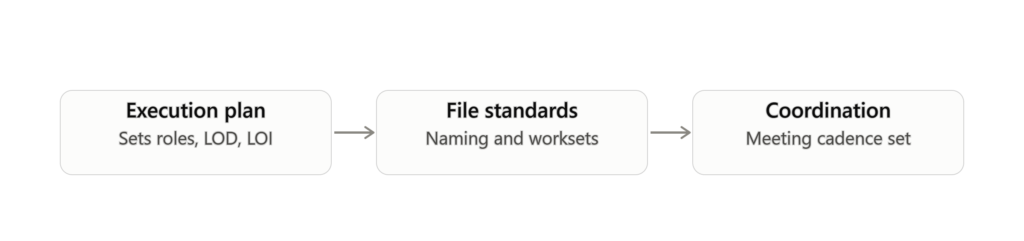
A consultant who has run this setup before knows which shortcuts a project team will regret. That’s usually worth more than the hours it takes to do it properly.
Catching Problems a Trade Model Won’t Show You
A trade model can pass every automated clash test and still be wrong. Ductwork can be clash-free and still be unbuildable because nobody checked maintenance access above a ceiling that will never come down again. A structural connection can be geometrically correct and still create a sequencing problem for the electrical rough-in three floors up.
Software finds overlapping geometry. It doesn’t know which trade can reasonably move, what a schedule constraint means for a routing decision, or whether a contractual scope boundary makes a “simple fix” actually complicated. That judgment comes from someone who has coordinated enough real projects to recognize the pattern before it becomes a change order.
The Real Cost of Skipping a BIM Consultant
Rework Nobody Budgeted For
A clash caught during coordination costs a meeting and some modeling time. The same clash discovered during rough-in costs labor hours, material waste, and schedule days while crews wait for a resolution. On a project with dense mechanical and electrical systems, that gap adds up fast, and it rarely shows up as a single dramatic failure. It shows up as a dozen small delays that quietly erode the schedule.
When In-House Is Actually Enough
It’s worth saying plainly: not every project needs an outside consultant. A team with an established BEP, a modeler experienced in your specific scope, and a track record of clean handoffs between disciplines can run coordination internally on a lot of projects without issue. Bringing in outside support makes the most sense when the project introduces something your team hasn’t handled before a new sector, an unfamiliar CDE platform, a compressed schedule that leaves no room to learn on the job, or a scale of coordination that would otherwise pull your best people off everything else they’re doing.
What to Look for in a BIM Consultant
Project-Type Experience, Not Just Software Certifications
Software proficiency is table stakes. What actually predicts a good outcome is whether the consultant has coordinated the type of project you’re running. Healthcare, transit, and mixed-use each come with constraints that don’t show up on a typical commercial job: infection control zoning, phased construction in occupied buildings, owner-mandated BIM standards, multiple prime contractors reporting through different chains. For a fuller look at how that breaks down by service type, we’ve covered it in more detail in our piece on BIM consulting services.
How They Fit Into a Team That’s Already Running
A consultant who can’t integrate into an existing team’s rhythm creates more friction than they resolve. Ask how they communicate during coordination meetings, how quickly they turn around review comments, and whether they’ve worked with teams distributed across time zones or multiple firms. The best BIM consulting companies operate as a genuine extension of your project team, not a separate workstream you have to manage.
Questions Worth Asking Before You Sign
A short conversation up front saves a lot of friction later. Ask how they measure success on past projects, clash reduction counts, RFI volume, or schedule performance are more useful answers than a list of software licenses. Ask who specifically will be on your project day to day, not just who’s on the sales call. And ask what happens when a disagreement comes up between two trades about who should move: a consultant with real coordination experience will have a clear answer, because they’ve been in that room before.
It’s also fair to ask what a BIM consultant needs from you. Good BIM project management is a two-way process. If a firm can’t tell you what information, access, or decisions they’ll need from your team and when, that’s usually a sign the engagement hasn’t been thought through past the proposal stage.
A Recent Example: Lions Gate Hospital
On the Lions Gate Hospital project in North Vancouver, coordination had to account for phased work in an occupied facility, tight ceiling space typical of healthcare renovations, and multiple disciplines working against a schedule that didn’t leave room for late surprises. That’s the kind of project where the setup work upfront, the BEP, the coordination sequencing, the constructability review before major milestones, determines whether the field experience is smooth or reactive.
Bringing In the Right BIM Consultant
BIM consultants across Canada vary widely in how they scope this work, and the right fit depends on your project type, your internal team’s experience, and how much of the coordination you want to keep in-house versus hand off. At BIMBAM Designs, we work with contractors and owners at whatever point in that spectrum makes sense, from full BIM consulting engagements through to standalone coordination or modeling support.
If you’re weighing whether a project needs outside BIM consulting support or whether your team can run it internally, see how Bimbam works and get in touch before the coordination gaps show up in the field instead of in the model.