
Introduction to BIM Modeling
If you’ve been around construction long enough, you’ve probably seen the same mistakes
repeat themselves over and over again. One trade installs too early. Another trade finds out too
late. Somebody trusted a drawing they shouldn’t have trusted. Then the blame game starts
while the schedule burns.
Old-school contractors used to say, “Problems on paper are cheap. Problems in the field are expensive.” That’s exactly why BIM modeling has become such an important part of modern construction projects.
At BIMBAM Designs, we’ve worked on some of the largest and most technically demanding
projects in British Columbia, from massive healthcare facilities to underground transit
infrastructure. And if there’s one thing experience teaches you, it’s this: the projects that go
smoothly are never the ones with the fewest problems. They’re the ones that catch problems
early.
That’s where BIM earns its keep.
This article breaks down the five biggest benefits of BIM modeling, not from a software
salesman’s perspective, but from the viewpoint of people who have spent years coordinating
real projects with real deadlines, real trades, and real consequences.
What is a BIM Model?
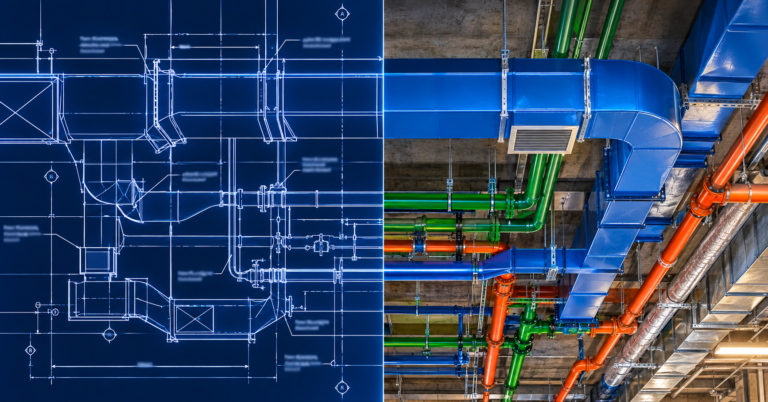
A BIM model is a detailed 3D digital representation of a building. But unlike old CAD drawings, a
BIM model carries actual information inside it. Every duct, pipe, wall, beam, and device can
contain dimensions, material data, installation details, and coordination information.
Think of it this way. A traditional drawing tells you what something should look like. A BIM model
tells you how it actually goes together.
And that changes everything.
Instead of every subcontractor working from isolated drawings and hoping things line up in the
field, BIM allows everyone to work from one coordinated source of truth.
Why BIM Modeling Matters for Construction Projects
Building information modelling (BIM) isn’t really about software. The software matters, sure, but
BIM for construction is more about process, communication, and accountability.
The best BIM teams don’t just “draw in 3D.” They think ahead. They ask questions before
construction starts, and they look at how systems will actually be installed instead of assuming
everything magically fits.
That mindset is becoming essential in Canada’s construction industry, especially on healthcare,
institutional, and infrastructure projects where complexity has reached levels that simply cannot
be managed effectively in 2D anymore. Following BIM best practices from project kickoff — not
as an afterthought — is what separates high-performing teams from the ones still putting out
field fires.
And looking ahead, AI is going to push this even further.
Right now, BIM still relies heavily on experienced coordinators spotting problems manually. But
over the next decade, artificial intelligence will likely play a major role in clash prediction,
automated routing optimization, schedule forecasting, quantity tracking, and even identifying
coordination risks before teams notice them themselves.
The contractors and consultants who embrace that shift early will have a massive advantage.
The future of BIM probably won’t be humans versus AI. It’ll be experienced construction people
working alongside AI tools that help them make smarter decisions faster.
Benefit 1: Enhanced Collaboration
The Importance of BIM Collaboration
One of the biggest problems on construction projects has always been fragmentation.
Mechanical is doing one thing.
Electrical is doing another.
Structural has their own priorities.
Architectural changes something at the last second.
Then everybody meets on-site and discovers half the systems are trying to occupy the same
space.
That’s not bad luck. That’s what happens when teams work in silos.
BIM coordination changes that completely.
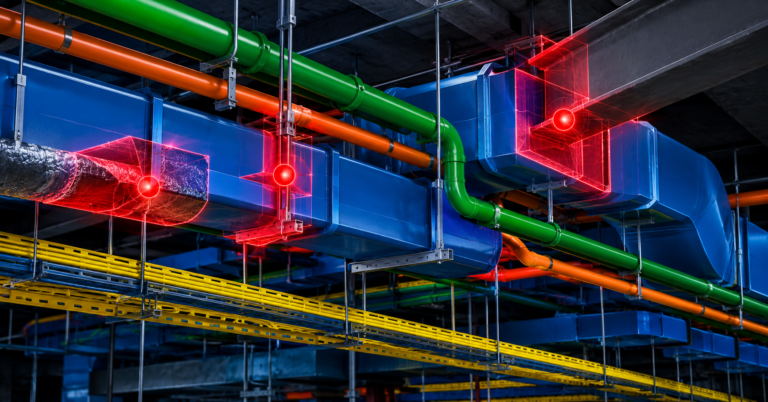
When all disciplines are coordinating within the same shared model environment, conflicts get
identified before fabrication begins and before installers are standing around waiting for
answers.
And trust me, nothing drains money faster than crews waiting around for decisions.
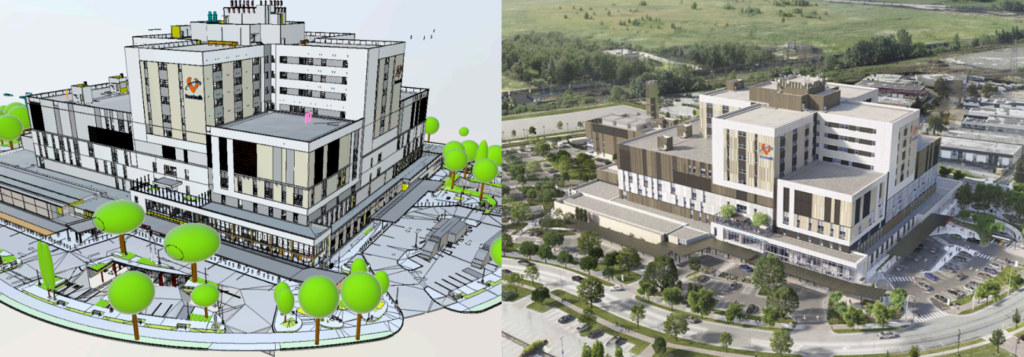
On the New Surrey Hospital and BC Cancer Centre project, one of the largest healthcare
developments in Canadian history, we worked across both the IMIT systems scope and
HVAC/mechanical ductwork scope simultaneously. Projects of that scale don’t survive without
constant collaboration between trades.
The lesson we’ve learned over the years is simple: the best BIM projects are not necessarily the
ones with the fanciest technology. They’re the ones where teams actually communicate.
How We Approach Collaboration
At BIMBAM Designs, we operate remotely with team members working across multiple time
zones. Some people assume remote collaboration creates communication issues. In reality, if
the systems are organized properly, it often improves communication because everything
becomes more intentional.
We attend coordination meetings consistently, even when our direct scope isn’t the main topic.
Experienced contractors know important project decisions rarely arrive with a warning label
attached.
Sometimes one casual conversation during a coordination meeting prevents weeks of rework
later.
Internally, our team communicates constantly between project leads and modelers. Problems
get discussed early instead of buried until deadlines get close.
That proactive approach is what keeps coordination efficient and keeps clients confident.
Benefit 2: Improved Project Management
BIM Project Management in Practice
Good project management has never been about fancy software dashboards.
It’s about having accurate information early enough to make good decisions.
BIM helps make that possible because quantities, schedules, and coordination information are
connected directly to the model itself. BIM-based quantity takeoffs feed directly into procurement
planning, reducing the guesswork that costs money at every stage. When model data is reliable,
procurement becomes more accurate, scheduling becomes more predictable, and field teams
gain confidence that what’s shown digitally can actually be built.
The older generation of superintendents used to walk projects constantly because they knew
problems hide in the details. BIM gives project teams another layer of visibility before work even
begins.
And that matters more than ever today because construction schedules keep shrinking while
project complexity keeps growing.
The BIM Process: A Step-by-Step Guide
Most BIM workflows follow a fairly structured process:
- BIM Execution Plan (BEP): Defines standards, responsibilities, file requirements, and
expectations. - Discipline Modeling: Each trade develops their systems according to the agreed level of
development. - Coordination & Clash Detection: Models are combined and reviewed to identify conflicts.
- Construction Documentation: Coordinated models generate shop drawings and fabrication
deliverables. - Handover & Facility Data: Final models are updated to reflect as-built conditions.
Simple on paper.
Hard in reality.
The challenge isn’t creating a BIM process. The challenge is maintaining discipline throughout
multi-year projects when deadlines tighten and pressure increases.
On the Cowichan District Hospital project, our HVAC scope alone produced more than 2,000
drawing revisions over the life of the project. Without a strong BIM process, that amount of
coordination would become chaos very quickly.
Benefit 3: Increased Efficiency with 3D BIM Modeling
Understanding 3D BIM Modeling
A model is only valuable if people trust it.
That’s one of the biggest truths in BIM.
Poorly built models create confusion. Trades stop relying on them. Coordination becomes
reactive instead of proactive. Then everybody slowly drifts back toward solving problems in the
field the expensive way.
That’s why modeling quality matters so much.
At BIMBAM Designs, our focus isn’t simply producing attractive 3D visuals. Our BIM modelling
services are built around accuracy, models detailed enough to support coordination,
fabrication, installation, and long-term project delivery.
Optimizing for Efficiency, Not Just Conversion
One of the most common mistakes in BIM is treating design models like finished coordination
models.
Experienced contractors know design intent and installation reality are rarely identical.
If you blindly inherit inefficient routing from design documents, you also inherit unnecessary
clashes, installation headaches, and wasted labor.
That’s why we rethink routing from a constructability perspective from the beginning.
We look at how systems can actually be installed efficiently in the field, not just how they were
originally drawn.
That approach dramatically reduces clash counts before major coordination meetings even
begin.
And honestly, the best coordination meeting is the one where half the issues never existed in
the first place.
Impacts on Workflow and Productivity
When systems are coordinated properly before construction starts, the entire project runs
smoother.
Fabrication becomes more accurate.
Material waste drops.
Field installation speeds up.
Crews spend less time improvising.
Superintendents spend less time putting out fires.
On projects like the Broadway Subway extension, where underground space constraints leave
almost zero room for error, fabrication-ready BIM deliverables are not optional. They are
essential for keeping construction moving safely and efficiently.
Benefit 4: Effective Coordination
BIM Coordination Strategies That Actually Work
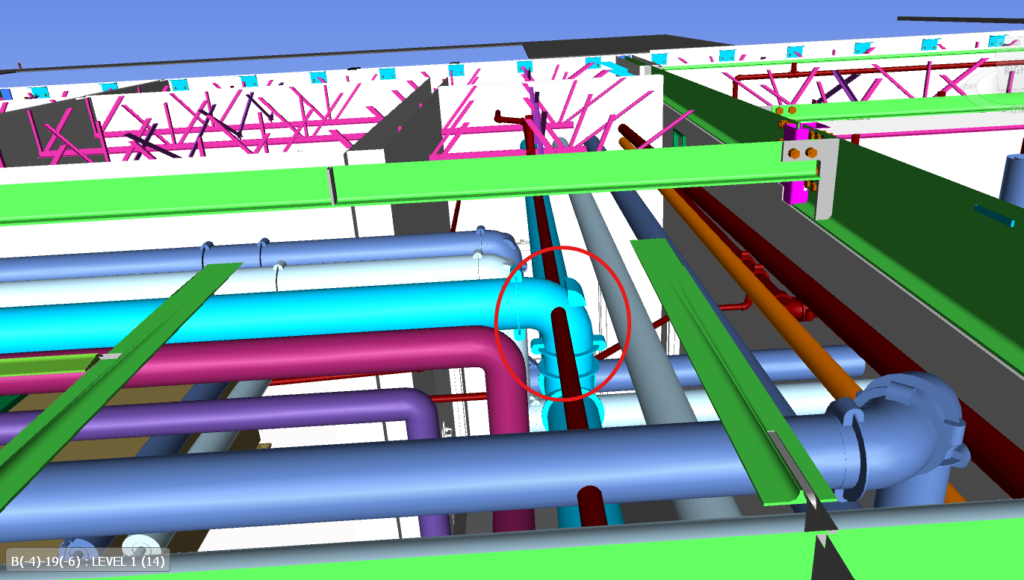
A lot of people think BIM coordination just means running clash detection software.
That’s the easy part.
The hard part is figuring out which trade moves, how systems get rerouted, whether clearances
still work, and whether solving one problem accidentally creates three new ones.
Real coordination requires construction knowledge.
Experienced BIM coordinators understand field installation realities. They know what trades can
reasonably adjust and what changes will create downstream problems.
That practical experience matters more than software shortcuts.
Our coordination goal is always simple: resolve as many issues as possible before they ever
reach the field.
Because once crews are standing there waiting, every minute costs money.
Resolving Conflicts Early Through BIM
Every contractor eventually learns the same painful lesson:
The later a problem gets discovered, the more expensive it becomes.
A clash solved digitally costs a meeting and some modeling time.
A clash solved during rough-in costs labor and schedule delays.
A clash discovered after finishes are installed can become a disaster.
That’s why BIM delivers such strong return on investment on complex commercial projects.
On healthcare projects especially, coordination precision becomes critical because ceiling
spaces are packed with systems competing for limited space.
On projects like Burnaby Hospital Redevelopment, coordinating low-voltage systems, RTLS
infrastructure, nurse call systems, and mechanical routing required a level of accuracy that
traditional 2D workflows simply cannot provide.
And here’s something important many people overlook: BIM coordination isn’t just about
clashes.
It’s also about trust.
When GCs and trade partners know the coordination team is reliable, projects move faster
because people stop second-guessing the information.
Benefit 5: Facility Management Integration
BIM for Facility Management Applications
One of the biggest misconceptions about BIM is that its value ends once construction finishes.
In reality, some of the biggest long-term benefits happen after occupancy.
A properly maintained BIM model becomes an operational reference tool for facility teams.
Equipment information, maintenance schedules, warranties, asset data, and replacement
history can all live inside the model environment.
That becomes incredibly valuable over a building’s 30- to 50-year lifecycle.
Especially in healthcare.
Hospitals are constantly evolving. Departments expand. Equipment changes. Systems get
upgraded. Having reliable digital building data saves enormous amounts of time and money
during future renovations.
We’ve worked on projects involving COBie-compliant asset management data, and while it’s
detail-heavy work, it creates long-term value owners appreciate years after construction wraps
up.
Long-Term Benefits of BIM in Facility Operations
A good BIM model keeps paying dividends long after ribbon cuttings and grand openings.
Future renovations become easier.
Facility teams troubleshoot faster.
Procurement information stays organized.
Asset management improves.
Owners avoid costly guesswork.
On massive mixed-use developments like the Oakridge Centre Redevelopment in Vancouver,
coordinated BIM data will likely support operations and future modifications for decades.
And this is another area where AI will probably transform the industry.
Future BIM systems may eventually monitor building performance in real time, predict
maintenance failures before they happen, automatically update digital twins, and help owners
optimize operational efficiency using live building data.
The line between BIM, facility management, and AI-driven building intelligence is going to get
thinner every year.
Closing
Construction has always rewarded people who solve problems early.
That principle hasn’t changed.
What has changed is the scale and complexity of modern projects. Hospitals, transit
infrastructure, mixed-use towers, and institutional developments simply involve too many
systems and too many stakeholders to coordinate effectively without BIM.
But software alone is not the answer.
Good BIM still depends on experienced people who understand construction, understand
trades, and understand how buildings actually come together in the real world.
At BIMBAM Designs, we bring that mindset to every project we work on. Our team combines
real-world construction experience with modern BIM coordination workflows to support some of
British Columbia’s most demanding healthcare, infrastructure, and commercial projects.
If you are planning a construction project that requires BIM coordination, BIM modelling, clash
detection, shop drawings, or fabrication-ready documentation, BIMBAM Designs can help
connect the digital model to how the work actually gets built in the field.
Whether you are still in design development or already preparing for construction, early
coordination can prevent costly delays, rework, and field conflicts later on.
Ready to eliminate costly field surprises? Contact BIMBAM Designs to discuss BIM modeling, BIM coordination, clash detection, and fabrication-ready project delivery for your next construction project.
And as AI continues reshaping the construction industry, the companies that combine practical
construction knowledge with advanced digital coordination tools will be the ones leading the
next generation of project delivery.
Because at the end of the day, construction technology only matters if it helps people build
smarter.