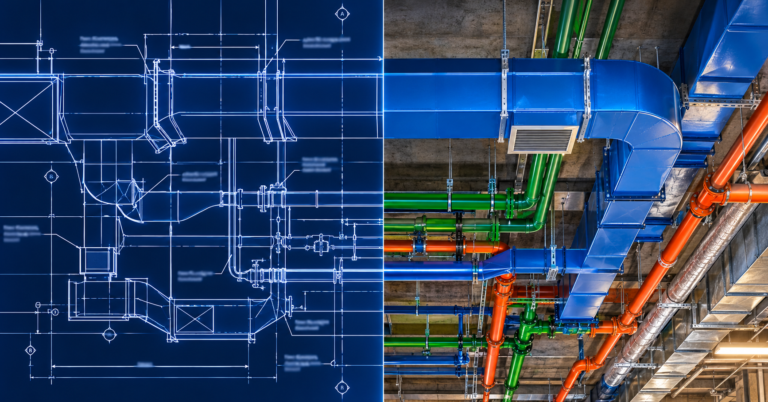

BIM for small contractors used to be optional. However, more general contractors now ask every trade on the job for a 3D model, even on mid-size projects. So if you run a small mechanical, electrical or plumbing company, you will probably face that request soon.
The good news is that you do not need a big BIM department to deal with it. This guide explains what BIM is, when you need it, what it costs, and how a small company can get started.
What is BIM, in simple terms?
BIM stands for Building Information Modeling. In short, it means you build the job in 3D on a computer before you build it on site. Autodesk gives a fuller definition of BIM if you want the detail.
Most teams use Revit to make the model. Each trade adds its own ducts, pipes, conduit and equipment. Then the team checks the model for clashes, which are places where two systems try to use the same space. As a result, you find problems on screen instead of on a lift.
Why BIM for small contractors matters now
Small companies often ask whether BIM is worth the trouble. In most cases, the answer depends on the jobs you want to win. For example, here is what a model gives a small trade contractor:
- Access to bigger jobs. Many tenders now list BIM as a requirement, so without it you cannot bid.
- Less rework. You fix clashes before install, so your crew does not rip out finished work.
- Faster installs. Your crew works from clear drawings, and you can also prefabricate more in the shop.
- Fewer disputes. The model shows who was in the space first, so arguments end sooner.
We cover these gains in more depth in our post on the benefits of BIM modeling.
When does a small contractor need BIM?
You do not need a model on every job. However, you almost certainly need one when:
- The contract or the GC’s BIM plan asks each trade for a model.
- The project is a hospital, school, lab or large commercial building, because the ceiling spaces are tight.
- You want to prefabricate pipe spools or duct sections.
- The job has weekly coordination meetings with the other trades.
On the other hand, simple fit-outs, small retail units and most residential work rarely need it. So check the tender documents first, and ask the GC what level of detail they expect. Our guide to LOD 400 explains those levels in plain terms.
What does BIM cost a small company?
This is where many small contractors get stuck, because doing BIM in house costs more than a Revit licence. First, you need the software and a strong computer. Second, you need a trained person to run it. Third, you need enough steady work to keep that person busy all year.
| In-house BIM | Outsourced BIM | |
|---|---|---|
| Upfront cost | Software, hardware, hiring and training | None |
| Ongoing cost | Salary all year, busy or quiet | You pay per project or per hour |
| Speed to start | Weeks or months | Days |
| Best for | Steady BIM work on most jobs | One-off jobs, busy periods, defined scopes |
Hiring is also harder than it looks. Good modellers are in short supply, and a wrong hire is expensive for a small team. Therefore, read our breakdown of the real cost of in-house BIM staff before you decide. If you do want to hire, our guide on how to hire a BIM modeller shows what to look for.
How small contractors can get started with BIM
You can start small and still meet the GC’s requirements. For instance, most small companies follow these steps:
- First, read the BIM requirements in the contract, so you know what you must deliver.
- Next, decide who on your team will attend coordination meetings and answer questions.
- Then choose between hiring a modeller and using outsourced BIM support for the project.
- After that, send your partner the drawings, specs and equipment submittals.
- Finally, review the model and shop drawings with your foreman before anything goes to site.
For a first project, outsourcing is usually the safer route, because you get an experienced team without a permanent cost. Still, choose your partner with care. Our list of questions to ask before you outsource BIM coordination will help you compare options.
BIM for small contractors: the short answer
You do not need to become a BIM company. Instead, you need a reliable way to deliver a good model when a job calls for one. For most small trades, that means outside help on the first few projects, and then a decision about hiring once the work becomes steady.
BIMBAM Designs supports small and mid-size mechanical, electrical, plumbing and structural contractors with Revit modelling, clash detection and shop drawings. You can see examples on our recent BIM projects page, or ask us about BIM support for your next project.