
Introduction to BIM Technology in Construction
On February 27, 2026, Anthropic published a statement about its dispute with the U.S. Department of War. It said access for individual and commercial customers was unaffected. This was a dispute over government use of Claude, rather than an overnight shutdown of AI models for ordinary customers.
For construction teams, the practical question is how to use BIM technology and AI while keeping control of project information, review decisions and fallback workflows.
Construction has a productivity problem that has nothing to do with AI. For decades, it has been the slowest-growing major industry in the economy. Productivity growth in U.S. construction was negative on average between 1987 and 2019. Every other major industry grew by at least 1 percent a year over that same period. Worldwide, construction productivity grew by only 10 percent between 2000 and 2022. The overall global economy improved by 50 percent over that span. The tools and machines the industry relies on were mostly invented decades ago. The sector has captured very little of the productivity boost that information technology delivered everywhere else.
That history changes the question. This is not really about whether AI will disrupt a high-performing industry. It is about whether AI can finally help construction catch up. BIM technology, used properly and paired with AI, is one of the few realistic paths for that to happen. Some BIM roles that exist today will not exist in their current form in ten years. Some will disappear faster than that. The people who understand both construction and technology will become significantly more valuable, not less.
This post does not sugarcoat any of that. It also does not predict a future where AI runs construction projects while humans watch. The reality is more complicated, and more worth understanding.
What is BIM Technology in Construction?
BIM technology in construction combines modeling platforms, cloud data environments, coordination tools, and AI-assisted workflows. Together, these let project teams plan, coordinate, and deliver buildings before a single piece of material arrives on site.
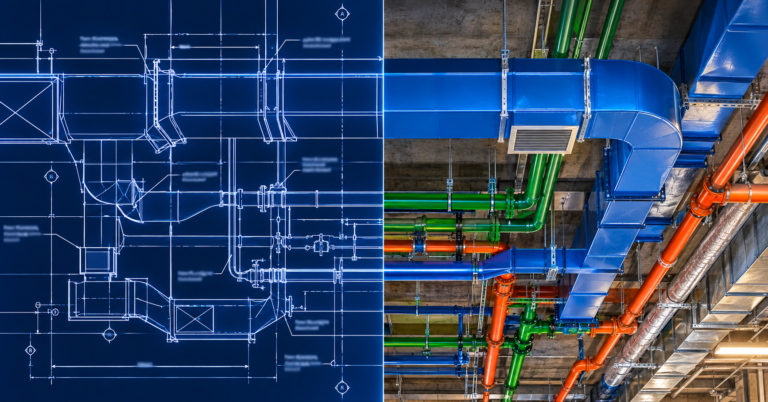
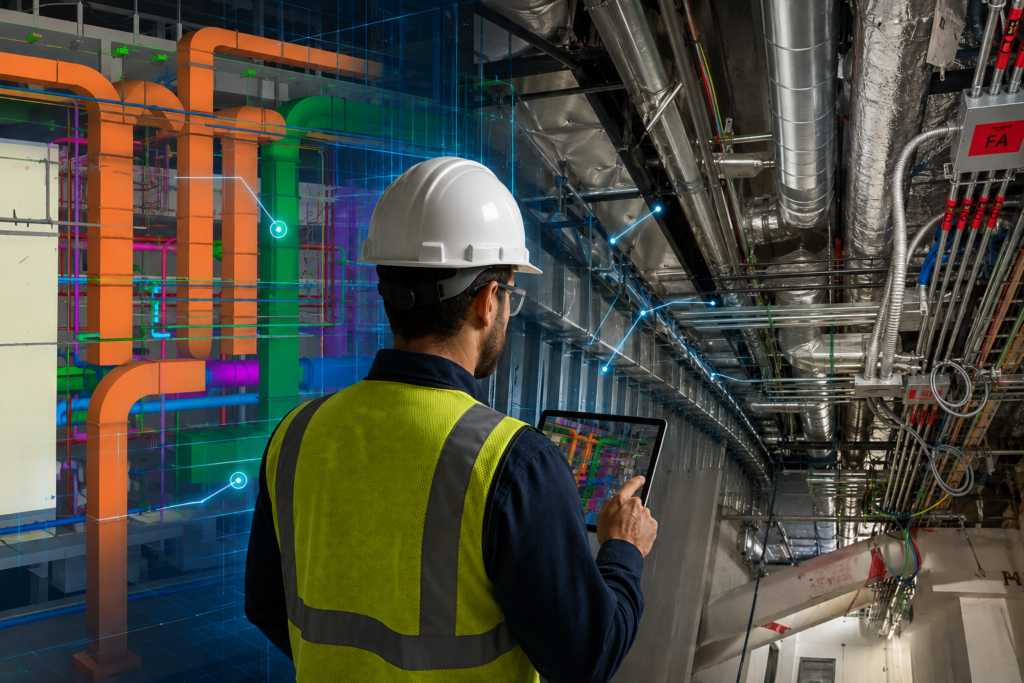
A BIM model is a data-rich digital representation of a building. Geometry, system relationships, installation sequencing, material properties, all live in a shared environment so every discipline works from the same coordinated information. When BIM technology is set up properly, a change made by one discipline updates across the model instead of getting lost in a chain of outdated drawings.
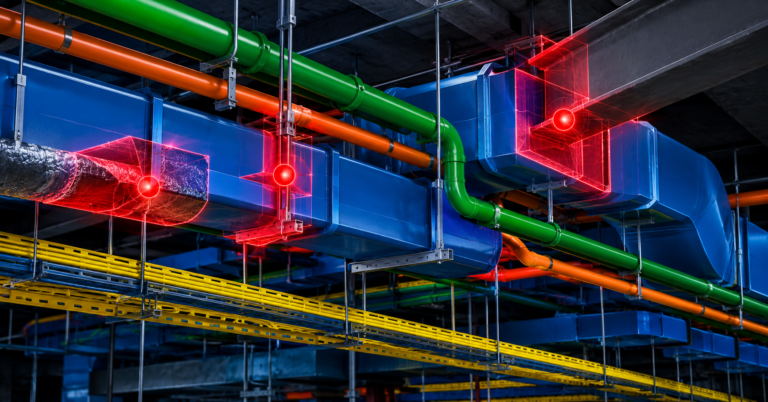
The intelligence layered on top of that foundation is what has changed. Clash detection used to require experienced coordinators reviewing model combinations manually. Now it is partially automated. Quantity extraction took days. Now it takes hours. Routing optimization once required iterative human judgment. Now it gets AI-assisted suggestions.
That is real progress. It is exactly the kind of technological leverage an underperforming industry like construction needs more of.
Key Features of BIM Technology
Integrated Project Delivery and Remote Collaboration
BIM technology makes integrated project delivery practical on complex construction projects. When all disciplines, structural, mechanical, electrical, plumbing, architectural, work from a shared model environment, conflicts surface digitally before they surface physically. Decisions that used to happen during rough-in now happen during coordination. Procurement planning gets more accurate. Fabrication gets more reliable.
On projects like major hospital expansions or transit infrastructure, ceiling spaces are packed and schedules are compressed. The cost of field surprises is significant. Integrated project delivery supported by BIM technology is the difference between a controlled project and a reactive one.
At BIMBAM Designs, our team works fully distributed across the globe. Canadian leadership brings direct experience on some of Canada’s most complex healthcare and infrastructure projects. Modelers work across time zones on live models in real time. That structure only works because we configure BIM technology correctly. Cloud model environments, structured file management, and reliable communication protocols are not optional extras. They are how the work gets done. When the setup is right, a modeler working remotely produces coordination-ready geometry that integrates directly into a project running on the other side of the world.
Data Management, Visualization, and Scan-to-BIM
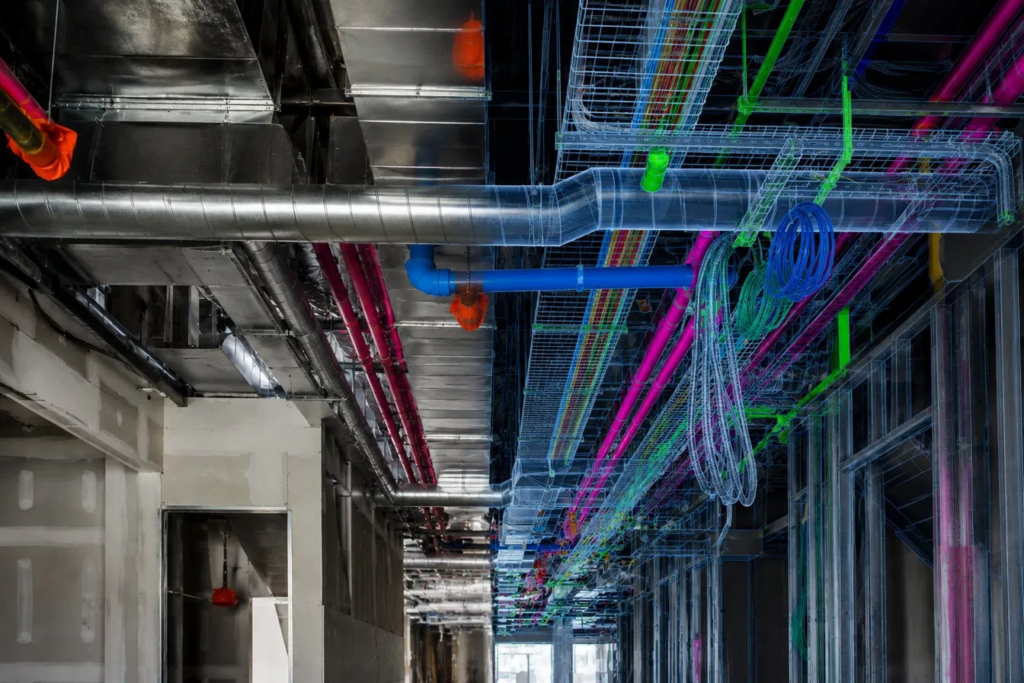
On renovation projects, healthcare expansions, and infrastructure upgrades, scan-to-BIM technology captures physical conditions as point cloud data and converts them into accurate BIM geometry. Starting coordination with accurate existing conditions, rather than drawings that may be decades out of date, directly affects whether coordination milestones hold. Occupied healthcare facilities have limited ceiling access, and patient operations cannot be disrupted. The difference between accurate existing data and outdated drawings is not a minor inconvenience there. It affects the schedule.
For owners, well-structured BIM data keeps delivering value long after construction wraps up. Equipment information, maintenance schedules, and asset data can all link directly to model elements. Facility teams spend less time hunting for information and more time managing operations. That is the same principle behind COBie-compliant asset management. The model becomes an operational reference tool, not just a construction deliverable.
AI Is Already Changing BIM, and Some of It Is Uncomfortable
What AI Does Well Right Now
Automated clash detection. Routing suggestions based on spatial constraints. Quantity extraction from model geometry. Schedule risk flagging based on coordination status. AI tools are already deployed in these areas or are in active development across major BIM platforms.
For repetitive, pattern-based tasks, checking whether two elements occupy the same space, extracting dimensions, generating standard report formats, AI works faster and more consistently than a human doing the same work manually. It also costs less. That is not a future prediction. It is the current state of the tools. It is exactly the kind of automation construction has lagged behind on for fifty years.
Which BIM Roles Are at Risk
Here is the part most industry content avoids saying plainly. Entry-level BIM modeling roles that are primarily production-focused face the most exposure to AI automation. That means drawing elements, running standard clash reports, and generating routine documentation.
If your value on a project comes from producing geometry from drawings and running clash detection software, that value will compress significantly over the next decade. This isn’t because the work lacks skill. AI tools are getting fast enough and accurate enough to handle those tasks with less human input. This pattern isn’t unique to BIM. Automation does this to production roles in every technical industry. Pretending it isn’t happening doesn’t help anyone plan for it.
Which Roles Become More Valuable
The roles that are harder to replace combine construction knowledge with BIM capability.
Understanding why a clash matters requires knowing how buildings actually get built. Which trade can reasonably move? What are the downstream sequencing implications? Does a proposed fix create an access problem three floors up? AI can flag the conflict. It cannot yet weigh the human, logistical, and contractual context that determines how someone resolves it.
Project-level BIM management, coordination leadership, client-facing consulting, and owner advisory work all demand judgment, communication, and construction experience that no current AI system can replicate. These roles are not just surviving the AI transition. They are becoming the scarce resource on complex projects. They are exactly the kind of work that can finally pull construction’s productivity numbers in the right direction.
AI Service Dependencies: What Construction Firms Should Plan For
The February 2026 dispute is a reminder to distinguish government-contract restrictions from access to commercial AI services.
Anthropic’s March 5, 2026 update described restrictions connected to Department of War contracts and said unrelated customer use was unaffected. For a BIM team assessing any AI service, check the applicable contract, data-export options and fallback process before making it essential to delivery.
The construction lesson isn’t to avoid AI. The lesson is to never let AI become a single point of failure in a critical workflow. The companies that will handle the AI transition well are the ones using AI to accelerate strong human expertise, not to replace it.
When the tool goes dark, the people who understand the underlying process still know how to work. The teams that handed their judgment over to the software face a much bigger problem.
Benefits of BIM Technology in Construction
Efficiency and Cost Accuracy
When BIM technology and AI tools work together properly, the productivity improvements are real and measurable. That matters enormously in an industry that has barely moved on this metric in fifty years. Coordination meetings cover more ground because issues surfaced before the meeting. Fabrication gets more accurate because shop drawings come from coordinated model geometry. Field teams have fewer questions because the team made more decisions in the model before anyone touched steel on site.
BIM models built to appropriate levels of development support procurement planning with quantity data accurate enough to drive real sourcing decisions. These aren’t rough estimates padded with contingency. Over the project lifecycle, that accuracy adds up: fewer budget surprises, more reliable scheduling, and less reactive procurement. For more on how this connects to BIM-based quantity takeoffs and estimation, our quantity takeoffs and estimation services and estimation services cover that process in more detail.
Risk Management That Starts Before Construction
Every conflict a BIM model resolves is a conflict that never becomes a field problem. A clash solved digitally costs a coordination meeting. The same clash discovered after finishes are installed can cost tens of thousands of dollars and weeks of schedule. That math drives the return on investment case for BIM technology on commercial and institutional projects. For a closer look at how this plays out across a project, the top benefits of BIM modeling for construction covers the coordination, facility management, and project management outcomes in more detail.
The Future of BIM Technology
Digital Construction and AI Over the Next Five Years
Over the next five years, AI tools embedded in BIM platforms will take on more of the pattern recognition work that currently requires experienced coordinators to do manually. Expect clash prediction before models are fully developed, automated routing optimization across discipline models, and schedule risk analysis based on coordination status and historical project data.
This will reduce the time required for routine coordination tasks significantly. It will also raise expectations. Owners and GCs who understand what AI-assisted BIM can do will have less patience for coordination processes running at pre-AI speeds, especially in an industry that has already fallen this far behind on productivity.
Digital Construction Beyond the Model
Point cloud scanning, drone site documentation, and digital twin platforms are pulling BIM technology beyond design and coordination. The gap between the model and the physical construction keeps closing. For owners, this means BIM data can support installation progress tracking, site logistics management, and real-time as-built updates. As a result, the value of the model now extends well past construction handover.
Sustainability and Standards
In addition, BIM technology feeds into sustainability analysis more directly now. A model with accurate material data and geometry can support energy performance modeling and lifecycle assessment. As a result, this analysis becomes practical at the project level rather than a separate exercise done after design is finished. The UK BIM Framework offers a useful reference for how building information modeling standards are evolving globally in this area.
The Companies That Come Out Ahead
The companies that benefit most from the AI shift already operate at high BIM discipline. Clean models, structured workflows, experienced leadership who understand construction. AI speeds up what is already working. However, it does not fix what is fundamentally broken, and it will not single-handedly fix construction’s fifty-year productivity slump either. What it can do is give well-run teams a real lever to pull.
At BIMBAM Designs, technology has always made the operation possible. We work fully distributed, coordinate across time zones, and support some of Canada’s most complex healthcare and infrastructure projects. None of that works without BIM technology configured correctly and used consistently. The tools matter. So does knowing exactly what they are for.
Understanding the difference between a BIM coordinator and a BIM manager matters even more as AI takes over the repetitive layer of coordination work, and having the right person in each role becomes critical. Knowing how to set up a BIM Execution Plan and project standards from the start also matters more, not less, as AI tools get layered on top of a project’s BIM consulting services foundation.
This is a real shift, and most project teams have not had time to figure out where they stand in it. That is exactly where BIMBAM Designs can help. We have spent years building BIM workflows that work across time zones, across disciplines, and now across AI tools. We can help your team figure out what to adopt, what to be careful with, and how to come out ahead of an industry that has been standing still for decades.
If you are evaluating BIM technology requirements on an upcoming project, or want a coordination partner who can help guide your team through this shift, contact BIMBAM Designs for BIM consulting before coordination challenges show up on their own.